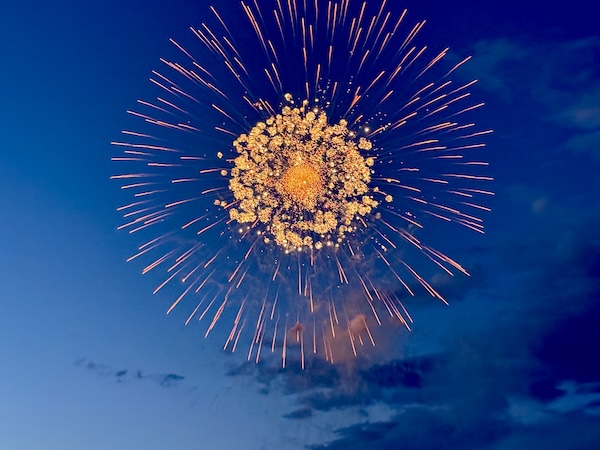
A large, bright orange firework explodes against a dark blue sky
Dear friends,
After the heat waves, cyclospora outbreak, and power outage–inducing thunderstorms, last week brought yet another reason not to go out: pollutant-filled smoke from the Ontario wildfires just north of us. Flashback to other times and places: California wildfires at the start of covid. Crop-burning season in Southeast Asia. Traffic-fueled, triple-digit AQIs in Bangkok and Phnom Penh—year-round, except when covid took cars off the roads, but by then the pandemic had made it impossible for us to return to our Bangkok apartment, whose contents arrived to my in-laws’ house in California, via cargo ship, several months later.
🚢
“My body felt out of time, out of place,” I had just read in Crystal Mun-hye Baik’s Before the Fire Dogs Steal the Sun (124). I stared in confusion at my phone. “500 - Hazardous,” the weather app announced, above a map in bruised shades of burgundy. It took a concerned text from family in California to remember that we should bust out the air purifier. The one from Bangkok had survived its trans-Pacific and cross-country voyages intact, though the filter was running low.
More temporal-spatial confusion: an email from Rev. Beth Goldring, letting me know that Tricycle’s Daily Dharma newsletter had linked to my 2020 article, “‘Stay Safe… Both from the Virus and the Racism,’” with the quote:
May we be free from the ills that plague us. May we find and make the refuges we need, not only to survive the difficult now but to thrive in our yet-to-be-determined shared future.
Some days, it feels like there’s nothing new under the sun. Some days, it’s as if no time has passed at all.
🛟
Having spent my early immigrant years in Pennsylvania, I might forever associate Midwest summers with fast-melting missile-shaped popsicles and blinking fireflies at the end of impossibly long days. Decades later, it’s still a carefree season. School is out, barbeques and lazy river floats are in. Granted, I’m not partaking much in either (blame vegetarianism and fear of toxic algal blooms). When is it not a season of calamity (wars that don’t end, fires that outdo themselves with every iteration)? Last week, buying groceries on an afternoon when the car’s interior reached 112ºF, I spotted an all-too-relatable T-shirt on a fellow shopper whom I’m guessing was in her fifties: Adulting, it said, following by a row of five stars, one filled in and the rest blank outlines. Would not recommend.
I always get a bit tongue-tied (finger-timid? word-shy?) about books I admire, so in lieu of an elegant summary or polished review, allow me to simply say how much I appreciated Crystal Baik’s deftly written, beautifully typeset second book. Before the Fire Dogs Steal the Sun: An Elegy lives up to its subtitle in providing hallowed witness and hard-won solace. A professor in gender and sexuality studies at UC Riverside, Baik’s genre-blending book is capacious enough to hold—with disciplined honesty and deep-rooted love—the carefree and the calamitous, the child with the firecracker pop and the mom (let’s face it, it’s usually a mom) tasked with sating sugar cravings on hundred-degree days.
🫗
Baik didn’t intend to write this book. But after her mother’s institutionalization in a psychiatric facility in December 2022, followed almost immediately by her father’s death two days after overturning his Camry in a park close to home, she needed “a haven for disclosure,” a
shelter for the torrent of questions that were difficult, even shameful, to ask out loud… I was not writing to “intervene” in a body of literature or to craft an “argument”… I took to writing because it was the only thing that seemed to loosen the density of grief lodged in my body. (4)
In engaging “writing as a corporal act and sacred practice” (60), Baik comes to relate to her father as an ancestor—and as a subject of “broader diasporic histories that transpired through colonial occupation, war, poverty, and peninsular divison” (4). Baik writes:
My father’s death, then, is not a loss to get over but rather a rupture that has birthed ways to feel and put into language the contours of a diasporic grief beyond a bounded ”I” or “me.” (125)
How fortunate we are that this grief, dislodged and transmuted through ancestral funerary rites—writing being one such rite—has woven itself into this haven of a book, a shelter that insists on
the joy the living must embrace and work toward. (130)
🥛
I’ve recently become the grateful custodian of two vintage file cabinets. Close to my height and age, the cabinets will surely outlive me. The only sign of their decades is the fact that they ended up at the university’s property disposition, priced cheaper than the hanging files needed to make them functional.
As a result, I now have a double-wide drawer full of irrefutable evidence that I am a hopeless sentimentalist when it comes to handwritten letters. Perhaps I can’t bear to throw them away because they attest to the 30+ mailing addresses I’ve inhabited—and the friendships that can make a foreign place feel more like home. (A new answer to the dreaded “Where is home?” question: closet beneath the stairs, cabinet on the left, second drawer.)
Or perhaps it’s because these letters mark the original site where I learned, as Baik illustrates in Before the Fire Dogs Steal the Sun, that
writing is a spiritual practice with consequence and stakes beyond individual yearnings. (61)
With all the moving, I never went to the same summer camp twice, so it is with happy astonishment that I find myself preparing for the fourth annual Roots & Refuge, an Asian American Buddhist writing retreat at the Barre Center for Buddhist Studies.
Last year’s retreat was the impetus for this Little Buddhist Days newsletter. Crystal Baik was part of the inaugural R&R cohort in the summer of 2023 at BCBS, where she wrote part of the book that today’s newsletter orbits around. Crystal’s longtime friend Susie Yeo urged her to come; Susie has been our beloved and indispensable retreat manager ever since.
Tracing the karmic relationships that led to the creation of Roots & Refuge would require a separate newsletter, but I’d be remiss not to name Aaron Lee (1983–2017) and Rima Vesely-Flad. Little Buddhist Days and Roots & Refuge: a handful of days per annum whose nourishment lasts the year. I like to think of them as milk-rice days, in a nod to Sujātā’s golden bowl of sustenance, the magical meal that fueled the Buddha’s enlightenment.
In times of calamity, may we be the recipients of milk-rice days; in times of carefreeness, their happy makers.
Til the next quarter moon,
~Chenxing