Dear friends,
I’m traveling for much of June, so this month’s newsletters will be an essay (split into two installments) that I wrote/read for the Half Natural/Half Technological event at the CLUSTER Museum in Ann Arbor on May 27th.
I spent the past weekend in Northern California for a dear friend’s surprise fortieth celebration (and yes, the twelve of us, from three time zones and five U.S. states, managed to pull off the surprise). Our youngest member, age one and a half, had two favorite expressions that he deployed throughout the weekend.
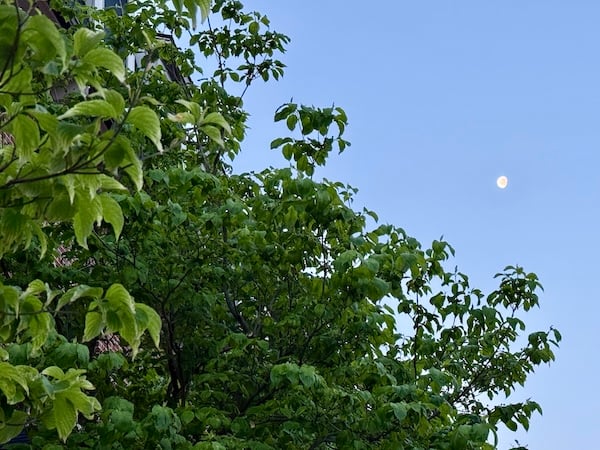
These summer days are a good time to catch the oldest of TVs in the daytime sky. May we learn from Rafi’s example of undiminishable delight and, upon spotting the moon in the morning sky, squeal with joyful abandon: La luna!!! Yay!!!!! La luna!!! Yay!!!!!
Til the next quarter moon,
~Chenxing
Written in communication with the artworks at the opening reception for the CLUSTER Museum exhibition I Hate Technology In Order to Use it Properly: Kim DeBord and Zach Debord’s Pisces, Joo Won Park’s Control Click, Linh My Truong’s Expand/Contract and Shigeko, Julie Zhu’s Scribble Scores and Ornithology.
🗓️
I write a newsletter called Little Buddhist Days on the first- and third-quarter moons, which makes it—roughly speaking—a biweekly, bimonthly, semimonthly, and fortnightly endeavor. Roughly, because lunar cycles do not obey the strictures of the Gregorian calendar.
The Gregorian calendar went into effect 444 years ago, in 1582. Most lunar and lunisolar calendars have forgotten their birth years, which tends to happen if you’ve been around for millennia.
Before he was hailed as the father of video art and a prophet of the digital age, Nam June Paik 백남준 created Moon is the Oldest TV (1965), an installation broadcasting a dozen stages of the moon on as many television monitors. Paik produced his lunar-esque images through the manipulation of magnets within the cathode-ray tubes.
The installation’s evocative title lends its name to Amanda Kim’s 2023 documentary Nam June Paik: Moon is the Oldest TV. Describing the 1965 installation, Paik recounts: “I discovered a moon... In the TV. By accident.”
He muses: “Oldest television set humankind had was the moon. People always gaze at moon, you know?”
📺
In the Shurangama Sutra, the moon is a symbol for enlightenment. The Buddha addresses his cousin and attendant Ananda:
Suppose someone is pointing to the moon to show it to another person. That other person, guided by the pointing finger, should now look at the moon. But if he looks instead at the finger, taking it to be the moon, not only does he fail to see the moon, but he is mistaken, too, about the finger. He has confused the finger, with which someone is pointing to the moon, with the moon, which is being pointed to. (54)
Paik was once asked if he was a Buddhist. His reply? “No, I’m an artist.” (179)
☝️
Later in life, wheelchair-bound by a series of strokes, Nam June Paik reports: “Yeah, brain is working. Mouth is functioning too.”
He weakly lifts a middle finger to the camera in an impish f***-you.
“I have a few more tricks to play before I die.”
In the next scene, a physically infirm Paik shuffles forward to meet Bill Clinton and South Korean President Kim Dae-jung at a 1998 White House state dinner. In that precise moment, Paik’s trouser fall to his ankles.
Whereupon we realize that he has gone commando for this special occasion.
Monkey business, or innocent accident?
🌕
An r/Buddhism Reddit thread from fifteen years ago is titled: “If you meet the Buddha on the road, kill him.”
Mephos asks: “Could someone explain this to me, treat me like i am 5. :-p. I’ve seen it in quite a few places but never really understood it.”
One redditor points Mephos to the quote’s originator, 9th-century Tang Dynasty Chan master 臨濟義玄 Línjì Yìxuán.
The quote in question appears throughout the Mahayana Buddhist canon:
逢佛殺佛。逢祖殺祖。逢羅漢殺羅漢。逢父母殺父母。逢親眷殺親眷。始得解脫。féngfó shāfó féngzǔ shāzǔ féngluóhàn shāluóhàn féngfùmǔ shāfùmǔ féng qīnjuàn shāqīnjuàn shǐdé jiětuō.
which Zen teacher Ruth Fuller Sasaki translates as:
On meeting a buddha slay the buddha, on meeting a patriarch slay the patriarch, on meeting an arhat slay the arhat, on meeting your parents slay your parents, on meeting your kinsman slay your kinsman, and you attain emancipation. (22)
Searching for this sentence on the AI-driven research platform Dharmamitra yields 49 entries. One of the entries cites the Zhiyue lu (指月錄, “Record of Pointing at the Moon”), a Ming Dynasty compilation—testament to the iconoclastic passage’s staying power.
Here is the context that couches all this slaying, in Sasaki’s translation again:
Followers of the Way, if you want insight into dharma as it is, just don’t be taken in by the deluded views of others. Whatever you encounter, either within or without, slay it at once… By not cleaving to things, you freely pass through.
Another redditor offers a different take for Mephos. “It means that you need to watch your back, cause the buddha might be a robot or possibly a cyborg. And them things pack a punch.”
🪓
By the time Nam June Paik arrived in New York at the age of 32, he had lived in Korea, Hong Kong, Japan, and Germany. In Darmstadt, a John Cage performance hit Paik with the force of satori: “He gave me the courage to be free. License to kill.”
Paik was very good at destroying pianos. By axe, and by tipping them over. The latter method seems, to the casual observer, as cruel as cow tipping, and just as difficult to execute.
He broke violins too. Not exactly a fair fight, size-wise.
In another clip from the Moon is the Oldest TV documentary, Paik says: “I don’t yet know what I will destroy. Maybe myself.”
🤖
Cellist and longtime Paik collaborator Charlotte Moorman recalls how his Robot K-456 (1964) spoke in the voice of JFK and shat little white beans. It was a flayed creature whose every component was on full display.
Control, click. Control, click. Let it be clear who is commanding whom.
“My work looks whimsical but it has profound background,” Paik reflects.
“I make technology ridiculous,” he adds.
After a 34-year hiatus, Paik returned to Korea for a visit. He hadn’t made it to either of his parents’ funerals. Two years after bowing three times to his parents’ grassy burial mound, Paik created Father (1986) and Mother (1986). Fashioned from full-size televisions, the pair of robots stood side by side, TV antennae for arms.
On the PBS page for Moon is the Oldest TV, Ryan Lee Wong writes:
Paik had a fraught relationship to Buddhism. He was born in 1932 into a Buddhist family, but said in interviews that though he grew up near a temple, his father was focused on making money and his mother was more superstitious than Buddhist. And though he reportedly never smoked or drank in observance of Buddhist precepts, he thought the religion was backwards and fatalistic.
💿
I borrow Moon is the Oldest TV from the Ann Arbor District Library. The disk whirs loudly through the 107-minute documentary, which takes me over two hours to finish with all the skips and hiccups. The blue light on my DVD player flashes steadily, a whale eye blinking from the deep. Afterward, I’m astonished to discover that the film isn’t decades old. (The TikTok clip should’ve been a dead giveaway.)
With his restless iconoclasm and endless creativity—an imagination that’s all expansion, no contraction—Paik seems more like a Pisces than a Cancer.
“Because of my really late non-success—still I’m not successful—I had still more variety of ideas,” he notes.
Cue Shunryu Suzuki’s classic quote from Zen Mind, Beginner’s Mind: “In the beginner’s mind there are many possibilities, but in the expert’s there are few."
🍎
Judging by his students’ reminiscences, Paik’s generosity and compassion rivaled that of 18th-century Buddhist monk Taigu Ryōkan 大愚良寛. Legend has it that Ryōkan caught a thief attempting to rob his mountain hut. Hermit’s home—nothing to steal. You’ve come a long way and shouldn’t leave empty-handed, said Ryōkan, who proceeded to give the intruder the clothes off his back. Sitting naked and gazing into the night sky, Ryōkan lamented that he couldn’t give the poor man this beautiful moon.
盗人に 取り残されし 窓の月
ぬすっとに とりのこされし まどのつき
nusutto ni / torinokosareshi / mado no tsuki
The thief left it behind:
the moon
at my window.