Dear friends,
Cleaning the sink in my bathrobe and bare feet, a crackling sound caught my ear. Before I could turn to investigate, whoosh!
It’s lucky I didn’t move. I would have met the shower door, metal frame and all, shearing clean off the hinge. (Tiimberrr!)
Astonished and unscathed, I stood amidst the glittering remnants. A second astonishment: The pop-and-crackle of broken safety glass sounds just like oven-fresh sourdough singing.
More astonishments: How long it takes to pick up a thousand tiny shards; how heavy the resulting bag of broken glass. This is like the weight of karma, I thought. Miniscule, seemingly inconsequential actions, in the aggregate, have heft. They cut; they contain; they act on us, and on the world. Many years ago, I attended a workshop by Julie Thi Underhill on “Art Intersecting Life: Creative Engagements with the Personal and Political.” From my notes that day:
Little bits of commitment accumulate
💥
Removing errant shards from the bookshelf, I pulled out my copy of Audre Lorde’s The Cancer Journals: Special Edition, a 1997 reissue—with photos and posthumous tributes—of the 1980 publication by Aunt Lute Books. I’d picked it out from the Lute’s basement storehouse when I worked at the nonprofit women’s publisher many years ago.
Rereading the book in these shamelessly racist times, I feel as if Lorde’s writing has hardly aged a day. Some excerpts from her journal entries in the season of pain, despair, and reckoning after her modified radical mastectomy (pp10–14):
4/16/79
The enormity of our task, to turn the world around. It feels like turning my life around, inside out. If I can look directly at my life and my death without flinching I know there is nothing they can ever do to me again. I must be content to see how really little I can do and still do it with an open heart.
9/79
There is no room around me in which to be still, to examine and explore what pain is mine alone—no device to separate my struggle within from my fury at the outside world’s viciousness, the stupid brutal lack of consciousness or concern that passes for the way things are.
11/19/79
I want to write rage but all that comes is sadness. We have been sad long enough to make this earth either weep or grow fertile. I am an anachronism, a sport, like the bee that was never meant to fly. Science said so. I am not supposed to exist. I carry death around in my body like a condemnation. But I do live. The bee flies. There must be some way to integrate death into living, neither ignoring it nor giving in to it.
7/10/80
If I cannot banish fear completely, I can learn to count with it less. For then fear becomes not a tyrant against which I waste my energy fighting, but a companion, not particularly desirable, yet one whose knowledge can be useful.
🔥
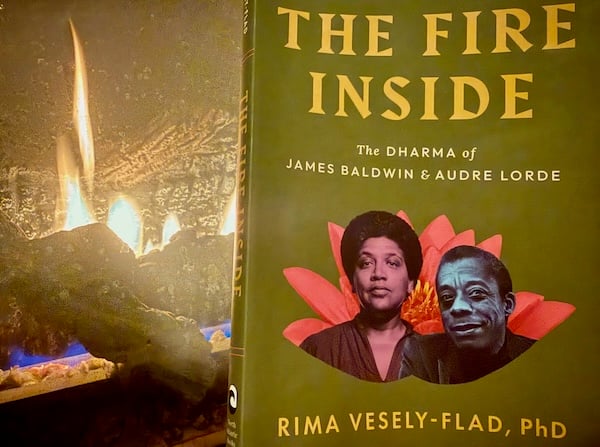
In The Fire Inside, The Dharma of James Baldwin & Audre Lorde, just published last week, Rima Vesely-Flad, founder of the Black Buddhist Studies Initiative, honors Audre Lorde and James Baldwin “as spiritual ancestors who had paved a way out of no way” (112), luminaries who helped her connect Buddhist teachings on suffering and freedom with Black, queer, and Palestinian lineages of struggle and liberation. This searing, searching book urges us toward a “practice of fearlessness” (46) that embraces karma
Actions, words, and thoughts have long consequences that “proceed forward, from life to life, generation to generation” (16, citing Jessica Zu, author of the recently published Just Awakening)
and anger
Through the process of honoring all that arises, I can validate anger as a moral response to harm, as an outrage rooted in self-love and love for others (126)
and sensuality
“to respect and rejoice in the force of life, of life itself, and to be present in all that one does, from the effort of loving to the breaking of bread” (134, quoting Baldwin)
—a fearless that embraces, in fact, everything:
“One of the most basic Black survival skills is the ability to change, to metabolize experience, good or ill, into something that is useful, lasting, effective” (45, quoting Lorde)
❤️🔥
Abhaya, fearlessness, is the first entry in Maria Heim’s Words for the Heart.
Abhaya is a feeling of security, the lack of a need to fear. It occurs when people consider how they might offer it to others. How can I live so that other creatures need not fear me? (34)
In Buddhism, as in Jainism and Hinduism, “this assurance of security is configured as a gift (abhayadana),” Heim notes. If, as Nehru and Gandhi argued, the function of leaders is to make their people fearless, to cultivate the principled vow of nonviolence known as ahimsa, then we are drowning in dysfunctional leadership. What is the opposite of a gift? Insecurity and violence and sadism are rife; their punishments fall unequally upon us.
There will be no end to this newsletter if I expatiate on “the outside world’s viciousness, the stupid brutal lack of consciousness or concern that passes for the way things are.” Not that we should ever stop analyzing—personally and politically, systemically and intimately—the greed, hatred, and delusion that rob us of the gift of fearlessness. But what I most want to know is this, dear readers:
Where have you found abhayadana lately?
🌋
My answer to this question, in addition to The Fire Inside:
Billy Strayhorn was always the most unselfish, the most patient, and the most imperturbable, no matter how dark the day… He was my listener, my most dependable appraiser…
We would talk, and then the whole world would come into focus. The steady hand of his good judgment pointed to the clear way that was most fitting for us. He was not, as he was often referred to by many, my alter ego. Billy Strayhorn was my right arm, my left arm, all the eyes in the back of my head, my brainwaves in his head, and his in mine.
May our paths be cleared by the unselfish, the patient, the imperturbable, the listener, the dependable appraiser, the steady hand of good judgment. Abhaya-bestowing gifts in ourselves, in our friendships, among kinfolk, among strangers. Imagine what becomes possible with all these arms and eyes and brainwaves melded. Like grains of sand melted into protective, crystalline glass.
Til the next quarter moon,
~Chenxing