Dear friends,
By the second morning of our five-day Buddhist writing retreat with Ruth Ozeki, “yesterday” felt like last month—nay, last year. (In the best possible way.) Throughout the five days/months/years of To Study the Self: Zen and the Art of Creative Writing, we kept circling back to a passage from Eihei Dōgen’s thirteenth-century essay Genjōkōan:
To study the buddha way is to study the self. To study the self is to forget the self. To forget the self is to be actualized by myriad things.
When actualized by myriad things, your body and mind as well as the bodies and minds of others drop away. No trace of realization remains, and this no-trace continues endlessly.
Fans of A Tale for the Time Being will recognize Dōgen’s influence on this autofictional novel (Ozeki’s third) about a young girl named Nao and a novelist named Ruth. “The time being” is one possible translation for uji (有時), a concept coined by the thirteenth-century founder of Sōtō Zen that has prompted tomes of interpretation in the eight centuries since.
She established a writing habit long before arriving at formal Zen practice, Ruth told us, though her first encounter with Buddhism predated either vocation. Ruth’s Japanese grandparents visited New Haven when she was three. Tasked with calling them to breakfast, Ruth opened the door to find her grandfather sitting on the ground, legs crossed, eyes closed, body ever-so-slightly swaying. They were the same height! He opened his eyes and looked straight into hers: Ruth’s first experience of her maternal grandparents, and of Zen.
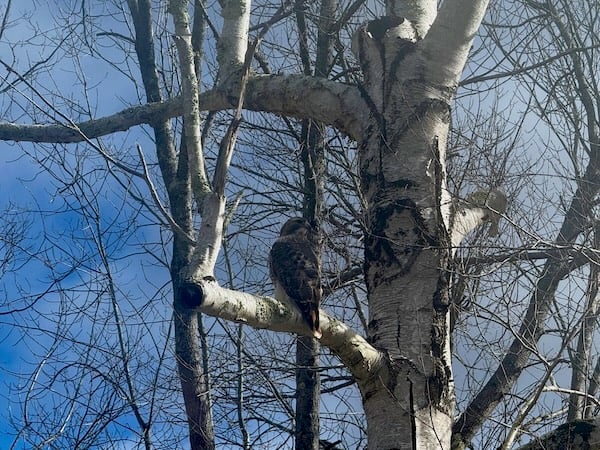
Leaving the Dharma Hall after the morning session when Ruth shared this formative childhood memory, we passed right beneath a perfectly still red-tailed hawk, so close I could have tapped its perch with the pole pruner my parents use for trimming their persimmon tree. After a few minutes, the hawk glided away, landing on a flimsy branch by the Thai spirit house. It was still swaying on that branch-swing in the wind as I walked to lunch, reflecting on Ruth’s grandfather and the way a micro-moment can lodge into one’s consciousness and reveal its significance over a lifetime.
How to sum up five years with Ruth Ozeki? Language falls short of experience, but I can offer up a swirl of memories:
I remember the pitter-patter of eighty-eight fists returning circulation to as many legs after shikantaza (just sitting, or, in Ozekian gloss, waiting for nothing).
I remember opening our sense gates to write about strong feelings. What if this emotion were a color, a sound, a taste, a smell, a texture, an animal, a household object? (Murky brown, turmeric on cheese grater, bark/earthy/slightly bitter, petrichor, scales on a monitor lizard, red salamander, electric hair clippers on the 3mm buzz cut setting.)
I remember delicious phrases: sloth and torpor (AN 7.61), penetralium of mystery (Keats).
I remember the pleasing synesthesia of a round sound.
I remember filling our notebooks with long lists of Joe Brainard–inspired “I remembers”.
I remember debating the ethically fraught portions of Brainard’s I Remember over borscht and bread.
I remember Ruth’s humor, curiosity, honesty, and playfulness: living embodiment of an art-making practice that transforms intractable problems into irresistible puzzles.
Also, there were handouts! From “Do You Want to Make Something Out of It? Zen Mediation and the Artistic Impulse,” an essay that Ruth wrote in the early 1990s:
(1) art isn’t just another job, it’s an endless exploration, and as with any exploration there are proliferating avenues of pursuit and no final successes, and (2) art is a necessity for humans, and we all need to find a way to participate in it
…
I believe that if the artist can be clear about the nature of the project that he or she is finally concerned with, and actively work at being clear about it—for clarity is never a given, it needs constant revision—just as if the religious practitioner, which is any of us, can be clear about the project that he or she is engaged in, it is possible to proceed with liveliness and integrity, despite the difficulties.
🌱 I have a dear friend who grows trees from seeds, a laborious, low-yield process that can take months or years. I have learned many things from this friend: patience, slowing down, the word “tubeling” (young seedling trees six to ten inches tall, grown in tube-like containers).
You can’t rush a seed. With supportive conditions (luck being one of them), it sleeps, creeps, and then leaps. Much like writing.
At the Vista Buddhist Temple online gathering earlier this month, I mentioned a Dharma friend who lives deep in the forest. Looking out the window brings joy at nature’s magnificence and pain at the phalanx of logging trucks entering empty and exiting full of cargo. They’d recently planted twenty-odd saplings in the forest, but despaired that it wasn’t enough.
But two dozen tubelings is twenty-four—nay, infinity—more than zero. Any one of them might someday grow into a tree that seeds countless progeny. Regardless of the outcome—even if every sapling perishes—is not the act of planting them an occasion for anumodana? From pages 56–57 of Marie Heim’s Words for the Heart:
anumodana
Applauding and Rejoicing in Others’ Virtue
(Pali and Sanskrit)
Anumodana is a feeling of jubilation and rejoicing upon witnessing others perform good deeds or acts of worship. The feelings of exultation at observing others’ spiritual advancement are encouraged as highly meritorious: when you give a gift or attain spiritual insight, I should celebrate. This counters envy and selfishness. In the Perfection of Wisdom Sutras, the Buddha himself is said to have achieved his awakening in part by rejoicing for countless eons at the merit of others.
Buddhist traditions have a ritually ordered sense of how one should celebrate others’ doing well. Many Buddhists see almsgiving to monks as a community event in which everyone—not just the donor—should endeavor to touch the gift and say “well done,” so that all might share in the merit and happiness of the gift. Giving is not a zero-sum game with a limited amount of merit redounding to the donor. Rather, it multiplies by the number of people who rejoice in it, just as a flame can be taken from one lamp to light many without diminishing the light of the first.
This cultivation of abundance (extravagance, even!) dovetails with Ruth Ozeki’s entreaty to take up Dōgen’s invitation to enter “the Dharma gate of bliss and repose”—in zazen, in writing, in living. Can ease and enjoyment match the power of strain and striving? Yes, one of the high school students of Listening to the Buddhists in Our Backyard realizes after her first visit to a local Vietnamese temple. YES! proclaims the late disability rights activist Alice Wong through her writing, her community organizing, her generosity and pleasure and glee.
At the Vista Buddhist Temple gathering, I shared this poem from Dr. Larry Ward’s posthumously published poetry collection Morning Night:
The Lamp
The most beautiful lamp I ever saw
was made from pieces of glass
left on the floor at the end of the day
in the artist’s workshop
The pieces sparkled, hidden
until seen as a dance of colors and light.
With tender care, a full heart’s hands reconstructed it,
singing the brilliance of new wholeness.
Hey you, on this day, look down
at the floor of your life, your heart.
See the pieces of pain and joy lying
on the floor waiting for you.
Do not be disheartened. With tender care and patience
take these pieces with the hands of a full heart.
Take these pieces of your precious life and beauty make
for yourself and for all.
In this relentless world of destruction and creation, may we stoke the flames of anumodana with tender hearts and faithful hands.
Til the next quarter moon,
~Chenxing