Dear friends,
In a year when the headlines felt much like Michigan winter for this California transplant—cheerless and cruel, capricious and calamitous—a recent news item gave me pause.
Mr. Robert Hung Ngai Ho, C.M., O.B.C., philanthropist, patron of contemporary Buddhism, newspaper journalist and editor, son of General Ho Shai Lai and grandson of Sir Robert Ho Tung, passed away peacefully in Vancouver, Canada on November 30, 2025, at the age of 93.
announced the lede of the Buddhistdoor Global article. (Mr. Ho established the online journal in 1995.)
Lion’s Roar reported:
Robert Hung Ngai Ho, Sr, founder of The Robert H. N. Ho Family Foundation Global, has died.
The foundation and the Buddhist world at large—the uncountable organizations, institutions, and individuals that have been direct or indirect beneficiaries of his generosity—mourn and remember him.
I am among those uncountable beneficiaries. The Ho Center for Buddhist Studies at Stanford hosted an event for my first book, Be the Refuge. Buddhistdoor Global’s Young Voices column compelled the high school students of L2BB to pour time and thought and multiple rounds of revision into their work, even though they weren’t getting grades for it—because writing for readers who care is meaningful and energizing. And it’s fair to say that all of us who value the cultivation and dissemination of Buddhist knowledge have benefited from The Robert. H. N. Ho Family Foundation Program in Buddhist Studies.
“My god, what a loss,” laments a Redditor on r/EngagedBuddhism. SentientLight goes on to compare Robert H. N. Ho to Gautauma Buddha’s chief male patron, a wealthy merchant whose name means “giver of food to the poor.”
Mr. Ho was like an Anathapindada-type figure in terms of his level of patronage of Buddhism, and particularly of Buddhist Studies programs all over the world. The Ho Foundation supports so many of the best organizations in Buddhist scholarship. May such incredible merit lead him quickly to awakening for the sake of all beings.
I looked for more articles commemorating this modern-day Anathapindika. My search yielded fewer remembrances than expected for someone whose generosity has so profoundly shaped the landscape of Buddhism in North America and beyond.
Robert Ho Hung-ngai, a celebrated Hong Kong journalist, philanthropist and avowed Buddhist, has died at the age of 93.
wrote the South China Morning Post. I’d become so used to the vexed typologies of American Buddhism—convert Buddhist, immigrant Buddhist, nightstand Buddhist, heritage Buddhist—that the phrase “avowed Buddhist” gave me another moment of pause.
What inspired Mr. Ho’s religiosity and generosity? I wondered.
According to Wikipedia, Ho only became religious as an adult. Born in British Hong Kong in 1932 and educated in the US the 1950s, he moved to British Columbia in 1989 and established the Tung Lin Kok Yuen Canada Society five years later. He went on to found the Tung Lin Kok Yuen Canada Foundation in 2005. The namesake of both: Ho’s grandmother, Lady Clara Hotung, born Cheung Lin Kok.
Lady Clara Lin Kok doesn’t have her own Wikipedia page, though a subsection on the page for Tung Lin Kok Yuen describes her as a devout Buddhist who was no stranger to suffering, and whose bodhisattva vows fueled her support of Buddhist and women’s education. (Established in 1935, Tung Lin Kok Yuen was the first free Buddhist school for girls and remains the only Buddhist seminary for nuns in Hong Kong.)
When drinking water, remember its source
was one of Robert H. N. Ho’s mottos. I imagine his grandmother as an underground spring, a fathomless lake, a mighty mountain, a magnificent glacier, a Dharma rain falling on everyone and everything without discrimination. Ho’s motto reminded me of the famous Bruce Lee “Be water” aphorism. I looked up the full quote.
Empty your mind, be formless, shapeless, like water. Now you put water into a cup, it becomes the cup. You put water into a bottle, it becomes the bottle. You put it in a teapot, it becomes the teapot. Now water can flow, or it can crash. Be water, my friend.
And then I traced its source to a 1971 episode of the TV series Longstreet (“The Way of the Intercepting Fist”) with Lee acting as a Jeet Kune Do expert named Li Tsung.
What I didn’t expect to discover: Bruce Lee is part of the Ho family tree!
🌰
I can tell the story of 2025 as a barrage of bad news, grenade after grenade.
This story has me flinching in fear, dodging one emergency after another, like the cat at the beginning of Gints Zilbalodis’ animated film Flow.
In writing this letter, I access a version of 2025 that feels like unspooling a paritta thread from me to Robert H. N. Ho to Lady Clara Lin Kok to Bruce Lee to buddhas to glaciers to rain.
This version of the story makes me feel like the local squirrels who’ve been seeking and stockpiling acorns all year long. A strategy that seems to have borne fruit, judging by the one I saw on my neighborhood walk yesterday, belly as generous as Hotei’s.
2025 has been a mast year for oak trees. Nut trees follow an unpredictable boom-and-bust cycle, as Robin Wall Kimmerer explains: “Some years a feast, most years a famine.” By design, nuts “are safety for hard times, the embryo of survival.”
Kimmerer argues:
In the settler mind, land was property, real estate, capital, or natural resources. But to our people, it was everything: the connection to our ancestors, the home of our nonhuman kinfolk, our pharmacy, our library, the source of all that sustained us. Our lands were where our responsibility to the creation was enacted, sacred ground. It belonged to itself; it was a gift, not a commodity, so it could never be bought or sold.
Like land, like Dharma. Each can offer safety in hard times. Abundance so munificent the survival of others is secured—and its own continuation as well. Nut trees’ MO.
🌰
The Anathapindikovada Sutta opens in the very monastery the merchant’s generosity made possible. Anathapindika is severely ill. One of the Buddha’s chief disciples pays him a visit and offers a sermon on what the householder must not cling to or identify with.
The dying merchant weeps.
“Never before have I heard a talk on the Dhamma like this.”
“This sort of talk on the Dhamma, householder, is not given to lay people clad in white. This sort of talk on the Dhamma is given to those gone forth.”
“In that case, Ven. Sariputta, please let this sort of talk on the Dhamma be given to lay people clad in white. There are clansmen with little dust in their eyes who are wasting away through not hearing [this] Dhamma. There will be those who will understand it.”
A final gift beyond anything money can buy: the teachings that lead to liberation.
🌰
Snow and ice got to the arugula on my condo balcony before I could harvest the tender leaves. The planter box and hanging pots are containers of frozen dirt now.
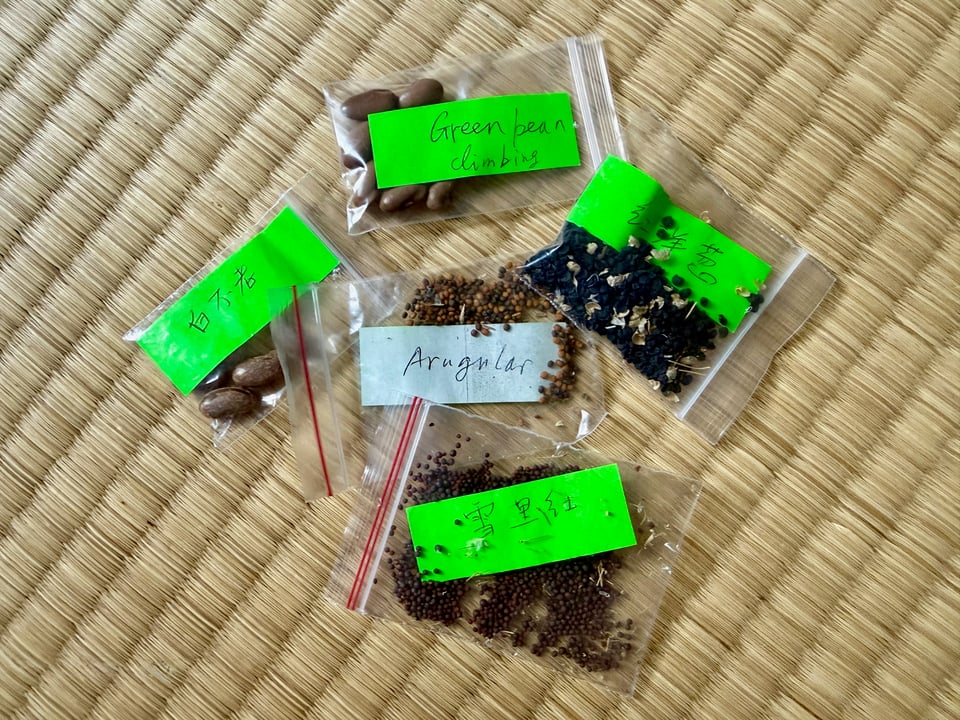
But the days will lengthen, and the thaw will come, and the seeds my parents brought when they visited this fall—Arugula(r) and friends, squirreled away from Mom’s balcony garden—will find a hospitable home yet, in those very planters.
This winter, I’ve been thinking about how my parents have lived through lean years and lush years.
I’ve been thinking of my mother’s grandmother, whose Buddhist chants never graced her great-granddaughter’s ear and never lodged in her granddaughter’s memory. When that granddaughter—my mother—makes dumplings and mooncakes and zongzi—painstakingly crafted calorie bombs that fit in the palm of your hand, like the Christmas cookies of this time and place—my great-grandmother feels like no stranger at all.
I hope at least one dimension of your life this past year felt like a mast fruiting. And if it’s been a bust year, I hope the deprivations have been eased by generosity. May we be alert to tiny treasures, confident in their (our) potential, contented on the path to ripening.
Til the next quarter moon,
~Chenxing