Dear friends,
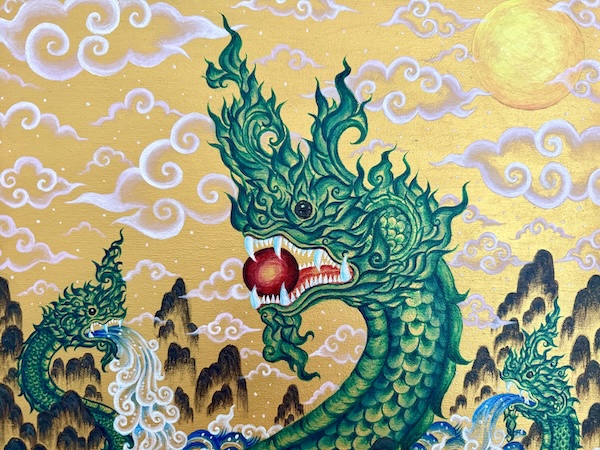
The recent heat dome transported me from Midwest summer to April in Cambodia/Thailand/Laos, when respite from the roasting temps and viscid humidity is hard to come by. (No wonder so many Southeast Asian new year traditions revolve around water.) Here in Michigan, I watched a neighbor hose down his grandchild on their front lawn. In Luang Prabang a decade ago, I dodged water gun–toting kids along the Mekong, whose banks had sprouted elaborate sand stupas festooned with zodiac animal banners. I hear tell that the sand mounds are offerings to naga spirits, whose serpentine bodies form many a temple banister in the Theravada Buddhist world.
🦫
Speaking of rivers and animals, beavers have been making their way back to the local waterways here. We’d read it in the news, and then my partner spotted one on a bike ride last month, after which they started cropping up everywhere: a podcast listen, a movie recommendation (Hoppers), an article about these industrious ecosystem healers. As a friend from my yoga shala pointed out, beavers are masterful builders of refugia.
Refugia, from the plural refugium:
an area of relatively unaltered climate that is inhabited by plants and animals during a period of continental climatic change (such as a glaciation) and remains as a center of relict forms from which a new dispersion and speciation may take place after climatic readjustment.
A little word big enough to contain nature and apocalypse and speculative world-building all at once.
🧨
Many people shaken by fear
So begins Dhammapada verses 188–192, which offer a Buddhist perspective on where we can find “the one refuge supreme… that will liberate from all suffering.” The verses are short, more injunction than narrative. If you love byzantine narratives as much as I do, the Dhammapada-aṭṭhakathā serves up a delightful backstory in the Aggidattabrāhmaṇavatthu: “The Story about the Brahmin Aggidatta” in Bhikkhu Ānandajoti’s 2024 revised translation of Eugene Watson Burlingame’s 1921 version of the text. (Burlingame’s title ignores our brahmin altogether for catchier fare: “The Monk and the Dragon.”)
Given his advancing age, Aggidatta, chaplain to King Pasenadi of Kosala, decides to renounce householder life, “spen[ds] all his wealth by way of alms in the course of a week” (!), and inspires ten thousand others to join him on the renunciate path. He counsels his followers: “Friends, in case any one of you should be troubled with sensual thoughts and so on, let each one of you so troubled fill a jar with sand from the river and empty the sand in this place” (from Ānandajoti’s translation).
A giant sand mound results. Not one to let perfectly good real estate go to waste, Ahicchatta, King of the Nagas, takes up residence.
Aggidatta further instructs his followers: “Pay homage to forests, mountains, parks and gardens, and trees; by doing so, you will be liberated from all ills of life” (from Daw Mya Tin’s translation).
The Buddha catches wind of this unorthodox teaching and dispatches one of his foremost disciples, the venerable Moggallana, to visit the forest-worshippers. Aggidatta begrudgingly relents to the venerable’s request for shelter. The former chaplain points Moggallana to the naga’s sand mansion, fully expecting his guest to be dead by the morning. (Emily Post’s Etiquette would not approve.)
Our naga king is none too pleased by this development, but before he can teach his interloper a lesson, Moggallana puts his magical powers to good use. Fourth of July–worthy pyrotechnics ensue. The monk spits smoke, the naga king ascends to the heavens in flames, his unwanted guest also bursts into flames and rises to Brahma’s realm—at this point, it looks like the dragon has literally roasted the monk.
In the end, Moggallana’s fiery pacification tactics prevail. “Thereupon the Nāga king surrounded the pile of sand with good things to eat, and creating a hood as large as the interior of a peak-house, held it over the elder’s head” (Ānandajoti). “When [Aggidatta and his followers] found the naga tamed, and meekly holding his head like an umbrella over Thera Maha Moggallana, they were very much astounded” (Daw My Tin).
Whereupon the Buddha arrives on the scene and extols the Triple Gem and the Four Noble Truths as the ultimate refuge.
🫏
Many centuries later, Eihei Dogen will find a way for Aggidatta to be right too. From the Busshō chapter of his 13th-century collection Shōbōgenzō:
to see the mountains and rivers is to see buddha nature; to see buddha nature is to see an ass’s jaw and a horse’s muzzle (Sōtō Zen Text Project, Treasury of the True Dharma Eye, Vol 1, p50)
Forests, mountains, parks, gardens, trees, horse mouths, donkey maws: liberatory possibilities in everything, everywhere, all at once.
🏖️
Another sand stupa appears in the commentary to Dhammapada verse 290. Lest today’s newsletter double in length, I can’t do justice to the matryoshka narrative in all its geographic and temporal leaps. Suffice to say that one of the stories involves the Buddha visiting Vesāli, a city whose former glory has been undone by famine and disease and amanussa (ogres in Daw My Tin’s translation). Spoiler alert: the Buddha is lavishly received by humans, nagas, and devas alike, and all is set right again.
His disciples assume this lavish welcome stems from supernatural power, but the Buddha corrects them: It’s not a result of “the power I now possess,” but “some small meritorious deeds in one of my previous existences” (Daw My Tin). He goes on to describe his past life as Sankha, a brahmin who blesses his son Susima to leave home to study, only to learn several years later that spiritually precocious Susima has achieved liberation and passed away.
The grief-stricken father visits the shrine to his young son, cleans the area, covers the ground with sand, sprinkles it with water, and sticks wild flowers into the wet ground. A small deed that eventually blossoms into the Buddha’s extravagant Vesāli welcome: the long, smooth, sand-covered path to the city; flowers piled knee deep; Ganges covered in lotuses; an endless procession of parasols. In short:
the whole round world was, as it were, uninterrupted decoration and holiday.
In these times, it seems impossible to imagine a world of uninterrupted decoration and holiday.
In these times, how can we afford not to imagine a world of beauty and ease for all?
Does the beaver know the benefits she confers to the world? Her dam a purifier of pollutants, an AC unit, a fireproof shelter. Architect of still waters, the beaver seems happiest doing exactly what she’s doing. May we join beavers and nagas and buddhas-to-be in the joyous act of refugia building—one small, daily, world-honoring, contentment-granting deed at a time.
Til the next quarter moon,
~Chenxing