Dear friends,
I’m at an “Encountering the Buddha as Teacher” retreat this first week of September, so today’s letter feels especially like snail mail, having been written a few days before you’ll be receiving it. Last time, I mentioned a botanical officemate. Here’s the story, as promised.
🍂
Does the beginning of 2026 feel like an eternity ago to you, too? In January, deep in the doldrums of dreadful winter, I brought home a pair of fern-embossed pots in an algal shade of aqua green. Then, in an act of optimism or desperation (quick Rorschach test: how do you feel about people who string up Christmas lights over Labor Day weekend?), I filled them with dirt. For the next four months, the heavy ceramics sat on a high kitchen shelf. Bereft of greenery, they grew more depressing with each passing day.
Does the start of summer also feel like forever ago to you? By mid-May, when even the most cautious of gardeners were snapping up seedlings at the farmer’s market, I joined the giddy throngs at Gracias’ Greenhouse and carted home an armload of houseplants. Gracias herself assured me that even I would have a hard time killing this hardy selection. (Allow me some poetic license here; I know Gracias is the surname of the couple who founded this now-third-generation greenhouse.)
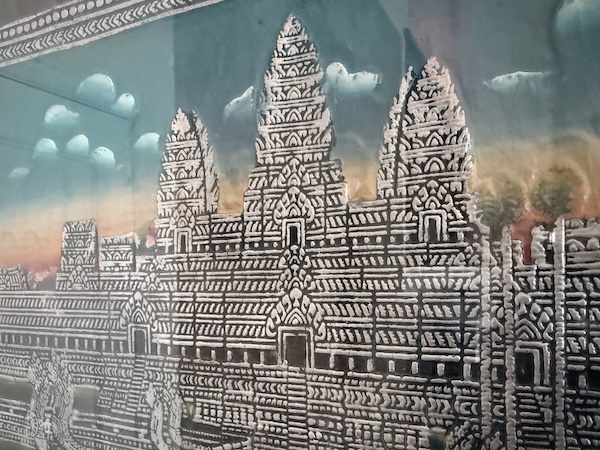
Gracias was right about the miniature umbrella tree, whose coiffure remains spray-gel perfect. But the miniature jade plant—of which I was particularly fond, because its corncob thicket of tiny teardrop leaves made it a dead ringer for the iconic central cone of the quincunx of towers at Angkor Wat—rebuffed rosy prediction. The perfectly symmetrical elephant bush, 1:141-scale crowning glory of Srok Khmer, not only did not live up to expectations, but looked like it wasn’t going to live at all.
Repotted into its ferny new digs, mini-Meru (Mount Meru being the five-peaked cosmological inspiration for Angkor Wat) promptly shed its emeraldine coat of lustrous leaves. I was left with a multi-armed coat rack in a mad-scientist’s petri dish of shriveled mouse ears.
😳
When shame sears through me, tattooing ABJECT FAILURE onto all of my cells, I can’t help but yearn for Devadatta’s fate. (On Thai temple walls, look for the mural of the monk being devoured by a hole in the earth, heading straight for Avīci hell.) Like Ānanda, Devadatta was a cousin of the Buddha. Unlike Ānanda, Devadatta is associated with arrogance, jealousy, sangha schisms, and multiple (failed) assassination attempts on the Buddha. Ergo his unfortunate end, in a rather punitive and imminent interpretation of karmic consequences: the ground beneath his feet splits open; flames from the lowest level of hell (they’ve got quite the reach) swallow him whole.
Absent the option of burying myself into the bowels of the earth, my next instinct is to bury the evidence of my failure. My denuded plant is only twelve inches tall, but so are most small dogs. Stuffing my alopecic charge into the neighbor’s garbage bin seems like a surefire way to trigger another wave of let-me-swap-places-with-Devadatta shame.
Admittedly, leaf loss may not merit this degree of melodrama. My particular flavor of shame hardly measures up to the pair of qualities praised in the Buddhist tradition as the “bright guardians of the world” (sukka lokapāla): hiri and ottappa. Shame and moral dread in some translations; conscience and respect in others. Emotions that should, in principle, prevent someone from siccing a drunken elephant on the Tathāgata.
Though without Devadatta, who would recur again and again as a character in the Jātakas (28 times as an animal, 46 times as a human)? Who would be the Buddha’s nemesis? Who would inspire scholars to elaborate “A Paradigm for Schism in the Vinayas: The Devadatta Narrative Complex in Its Historical Context”? Would literature exist without shame/conscience?
🌱
What about the jade plant, you ask?
As fans of the Hundred Acre Wood know, Winnie-the-Pooh is a Bear of Very Little Brain, and Piglet a Very Small Animal. I frequently feel like Pooh and Piglet both—though not often enough am I my own best friend.
That tripod of great faith, great doubt, and great determination that Koun Yamada advocates for? By generous estimate, my tripod has one leg and two small nubs. You could call me a Creature of Very Meager Faith. I was sure my plant was a goner.
🪴
Paragons of the paramita of kshanti, exemplars of patience more practiced than I’ll ever be, you know where this story is going.
Months after chalking Crown of Angkor up for dead, I noticed the coat rack’s arms had sprouted tender green joints with the briny glisten of marsh samphire.
And then these sea asparagus arms sprouted new leaves: sparser than the original ones, but also a touch bigger.
I wish I had a timelapse camera. Witness the fall of perfect symmetry, the ungainly struggle toward unfamiliar forms. An avalanche of leaves followed by a dance of hard-won emergence and ongoing relinquishment. (Many of the new leaves fail to stick around.) Like a molting chicken, Finial of Angkor won’t be winning any beauty contests anytime soon. As molting chickens teach us, regeneration isn’t always pretty.
⛩️
Don’t tell the other houseplants, but Baldie is now my favorite among all of them. This once-symmetrical elephant bush has given shape to my pain, past and present and continuing, as well as my capacity to grow from it. I see in this loss-wrought plant the shock of uprooting and immigration, the slow and mortifying rebuild. My memory draws a blank when I try to conjure the first and most painful migration, from Shanghai to Pittsburgh, but here at the onset of middle age, my body has things to say: about that definitive, defining, world-destroying move; about the subsequent relocations, aftershock upon aftershock.
Upon moving to Michigan from California, I resolved to listen to what my body had to say—then immediately regretted it. Why, I despaired, is my body speaking only in the language of physical pain?, effectively shooting a second arrow of psychological pain into the wound. (Sebene Selassie: “Why not me?”) I’ve experienced more pain (and more medical visits) in the past three years than in the past three-and-half decades prior.
I’ve had the same abode in Michigan for three years now. It’s been 21 years since I lived at one address for this long, 35 years since a three-year residence in one location contained more seeds for wholeness than sundering. In light of the five remembrances, a cavalier attitude toward disability rights is a vicious vote against the best interests of our future selves. From friends with chronic conditions, disability activists, patience-inducing jātaka tales, a patchily-leafed jade plant, and—above all—from the Dharma gate of pain itself, I’m learning to relate to pain not as proof of unworthiness or nemesis to eradicate, but as portal to compassion and teacher of equanimity. Stalwart protector and friend, even. (Only on clearheaded days.)
👑
I have a friend around my age who developed hyperthyroidism in her twenties, when teaching and service and dharma demands became overwhelming. Assisted by medication when necessary, she trod a gradual path toward balance. Offered the “permanent” solution of eliminating her thyroid through radiation, which would require lifelong hormone replacement therapy, she decided: If and when the tachycardia and hand tremors strike, these signals are not a problem. This condition is something I can learn to live harmoniously with.
I used to think the crowning glories of life were picture-perfect achievements. Now I suspect they might be the qualities that ferry us through our defeats. Most days, the earth supports us without discrimination. It’s our minds that threaten to swallow us whole.
Til the next quarter moon,
~Chenxing