Dear friends,
I began this AANHPI heritage month 6,000 feet above sea level, at the base of the Southern Rocky Mountains. Before making the journey to Colorado Springs, I’d zoomed into Prof. Nancy Lin’s Engaged Buddhism class at the Institute of Buddhist Studies to talk about the 2024 May We Gather pilgrimage. Tantalizing questions emerged from our conversation like slow-ripening fruit:
Where should we start the history of engaged Buddhism? What modes of action are available to engaged Buddhists? Art, ritual, emotion—what roles do they play in these different modes of engagement? Engaged with whom, and what, and how? Is there such a thing as disengaged Buddhism? How do the contours of our questions and understandings change when we center Asian American Buddhists?
This last question is the driving inquiry behind these idiosyncratic newsletters. It’s a quest(ion) that lacks definitive conclusion. I’m reminded of my first encounter with a fresh bael fruit, a gift from the Cambodian countryside that sat, incongruously, on the counter of our Phnom Penh apartment for weeks. It was one of those encounters that only generates more questions (is this hard ball really edible? how do I know if it’s ready to eat? is this a weapon or a fruit?), to which the best response is, simply:
Dig in.
At Colorado College (CC), I taught a three-hour class (“Asian American Buddhists Everywhere All At Once”) for a thoughtful group of undergrads, made new friends thanks to unexpected mutual connections (Buddhism and chaplaincy never fail to deliver karmic surprises), and delivered a public talk on “The Karma of Spiritual Kinship: Listening Notes from Buddhist Asian America.” I never give the same talk twice, which is both more interesting (keeps me on my toes) and more work (hoisted by my own petard!). At CC, in a city with few Asians and fewer Buddhists, I was keenly aware of the Granada War Relocation Center three hours east of us, known as Camp Amache to the thousands of Japanese Americans who were incarcerated there during WWII.
Several of the undergrads expressed surprise at the long history of Buddhism in this country. Consternation, too, at the persistence of racial and religious discrimnation against Asian American Buddhists. We considered the 127-year-old Buddhist Church of Sacramento, vandalized with white nationalist graffiti on this year’s Day of Remembrance, exactly 84 years after FDR’s Feb 19, 1942 signing of Executive Order 9066.
🪨
Accountability and transparency are the only way to stop multi-generational trauma across all racial communities
writes Karen Korematsu, daughter of civil rights activist Fred Korematsu, as quoted in CC professor Brandon Shimoda’s The Afterlife is Letting Go (10). The essay collection isn’t afraid to excoriate, yet remains vigorously humanizing throughout. The first essay is about a 2,000-pound stone and much more: guilt and innocence, feeling and form, burial and excavation, the murder of James Wakasa and the community’s care in his violent death’s wake, funerals and memorials and memories and museums in “that remote, Asianless place.”
Haunting as Shimoda’s multivocal collection is, I was glad for its company in Colorado Springs, a locale that felt remote and Asianless (though I knew it was no match for Topaz in Utah).
“Now that they’re gone, it’s like I want to be sad and angry for them by proxy” (132, Suzy Nakamura)
All descendants, then, are hungry ghosts, wandering the world desperate for connection, reciprocation (104)
“We have to take care of ourselves, we’re full of ghosts” (121, Emily Mitamura)
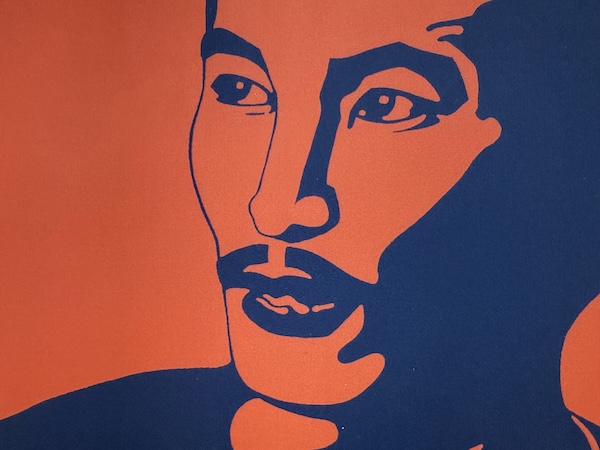
Before embarking on the twelve-hour journey home (there was a long delay in Chicago; I’ll be happy to leave O’Hare next month for a gathering of chaplains in higher ed), I took a six-mile meander from my downtown hotel. On that walk, I encountered two reminders of AANHPI heritage month: a Japanese restaurant featuring chopsticks font, and a banner of a (now-deceased) man who I later learned was a local community leader active in the Korean Catholic Church.
I found the latter to be more welcoming than the former, and thought to myself, representation matters. And also—here I heard The Afterlife is Letting Go interject—what matters lies beyond representation. Vince Schleitwiler argues that the burning/burial of Japanese-language materials and family heirlooms by JAs during WWII can be read as
a desire to preserve some aspect of a familial or communal past in a space beyond representation. What’s burned or buried, like the bodies of loved ones who have died, is not so much gone as secreted in an inaccessible realm that is beyond the reach of those who would do you harm, or misconstrue or appropriate what is yours… the burning of the treasured objects becomes linked to fire as a destructive but liberating force in an unjust order. (128–129)
✍️
As the title suggests, I’d originally intended for today’s letter to focus on Free Chol Soo Lee, the 2022 archival documentary film directed by Julie Ha and Eugene Yi that is screening on PBS until May 15. But the themes above—carceral systems that produce unconscionable levels of misery and pain, ghosts that haunt us into pursuits of justice and peace—are of a piece, and the TL;DR version of today’s letter is, simply: Don’t make the mistake I did. Don’t wait to watch FCSL.
How had I not known Chol Soo Lee’s story until last year, when I read the New York Times obituary for K.W. Lee, the trailblazing Korean American journalist in the hale tradition of “comforting the afflicted and afflicting the comfortable” who brought Chol Soo’s wrongful conviction to public awareness? A father figure to Chol Soo, K.W. demonstrated, in words and acts, that
We are all entangled in an unbroken human chain of interdependence and mutual survival. And what really matters is that we all belong to each other during our earthly passage.
The pan-ethnic, pan-racial movement that galvanized around Chol Soo and led to his release after ten years in prison—including four years on death row—predated the movement that arose after the 1982 murder of Vincent Chin by two employed white men who knew their victim was Chinese (belying the myth that the attackers were jobless and mistook Vincent for Japanese; see The Afterlife is Letting Go, 148–149).
Chol Soo Lee lived many lifetimes in his 62 years. Born into the Korean War with the most common name of the time. Desperately poor but lovingly cared for by his aunt and uncle in Korea after his mother left for America. U.S. immigrant of twelve struggling with English at school and abuse under his mother’s roof. Victim of the school-to-prison pipeline after being bullied and not having the language to defend himself. Juvenile held against his will in a mental institution where his limited English proficiency read as “crazy.” Lonely Korean street kid wrongly convicted of a Chinatown murder. Small Asian guy fighting to survive in a violent prison. Vulnerable target for refusing to take sides in the prison gangs. Killer of an inmate who belonged to the Aryan brotherhood. Exonerated defendant and celebrity community leader with few supports for reentry into civilian life. Man struggling with heroin addiction and depression. Ironic first-time Chinatown gang member. Burn survivor after a botched arson. Victim protection program member. Author of Freedom without Justice. “A grain of sand just trying to mix into life.” “Not a hero, just a human.”
Chol Soo Lee supporters united across all manner of divides—generational, geographic, linguistic, cultural, educational, economic, political, religious—within and beyond the Korean community. During his imprisonment, Korean Christians raised money to support a fair retrial and advocate for his release. After his death, Chol Soo’s funeral was held at Yeo Lai Sah Buddhist Temple in San Bruno, California, where Ven. Seouljo Lee led Korean Buddhist chants: spiritual analogues to the cries of “Free, Free, Chol Soo Lee!” that had bonded strangers into activist kin. The venerable had put the temple up as collateral toward Lee’s bond; Chol Soo spent his first day after being released from prison with the monastic.
Everywhere evidence of that unbroken human chain of interdependence.
Julie Ha went into journalism because of K.W. (“He kept urging us to dig up the truth, the whole truth, warts and all.”) She felt no choice but to produce Free Chol Soo Lee:
this poor Korean immigrant street kid—who was not a model minority—was worthy of a landmark movement because there are other Chol Soo Lees out there.
Eugene Yi recognized that the film could never have been made without the ”underground archive” that Asian American journalists, filmmakers, scholars and documentarians of the time preserved.
The act of preservation is an intentional act... They saw the value in this story for our community. After all, this was a transpacific, international effort led by Korean immigrants and Asian American radicals to free a man from death row. These mediamakers understood the importance of preservation, so they became caretakers and archivists of their own work.
For Ha,
How it all “ends” is really up to those of us who are still living. After learning about this story, this history, how will we respond? Will we allow it to change us, move us, inspire us to be more compassionate, to do our part in creating a more just society?
Yi sees the stakes in his three-year-old daughter.
I want her to feel free, to take up space. Can such a place exist? I don’t know. But in some ways, by connecting to our history, by taking up space, by existing, we are building something. So in a way, just being an Asian American today is a creative act. It has to be.
🤲
“What is an ancestor?” Shimoda asks in The Afterlife is Letting Go, to which his four-year-old daughter Yumi responds, “A dead person you love.”
We’ll all be dead someday. Perhaps our most urgent task is to love all that we can, as much as we can, while we’re still around.
Til the next quarter moon,
~Chenxing